HYCORE
The target of this proposal is the design and development of photo-catalytic systems for the utilization of solar energy in two separate ways: i) the production of hydrogen (H2) from water, and ii) the reduction of carbon dioxide (CO2) into useful fuel-products.
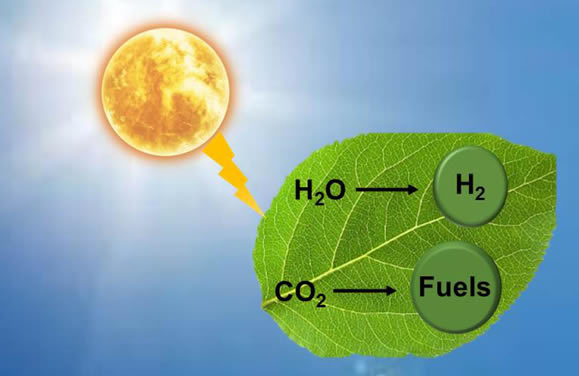
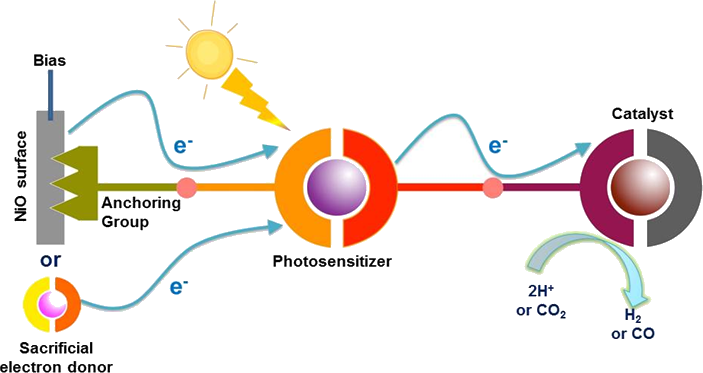
The proposed photocatalytic systems involve three basic components. Initially, the photosensitizer absorbs solar irradiation and then transfers an electron to the catalyst. The catalyst performs the respective catalytic conversion and finally the sacrificial electron donor regenerates the photosensitizer.
A recent and rather promising approach is the development of photo-electrochemical cells which use semiconductor materials such as nickel oxide (NiO). In this configuration the chromophore and the catalyst are covalently linked and immobilized on the semiconductor surface via a suitable anchoring group.
The significant advantages of this approach are:
i) the increased stability of the catalytic system and
ii) the absence of the sacrificial electron donor, since by applying an external bias the NiO photo-cathode is able to provide electrons to the whole system.